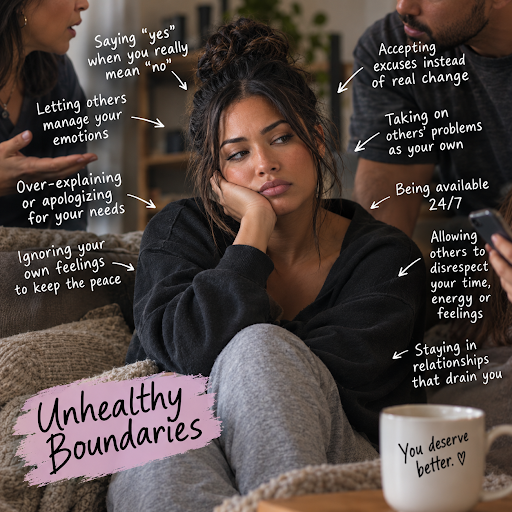
Healthy Boundaries: Counseling Tips
At Discovery and Wellness Counseling, we believe that healthy boundaries are one of the most important tools for protecting your emotional well-being, strengthening relationships, and creating a life that feels more balanced.
Boundaries are not walls meant to shut people out—they are clear, respectful limits that help you communicate what you need, what you can offer, and what does not work for you.
Do you struggle to say no,
Have you ever felt responsible for everyone else’s emotions,
Or often feel drained after spending time with certain people,
Boundaries are especially important for Aging Adult Caregivers, Parents, Career Professionals, Partners, or individuals who have learned to prioritize others’ needs before their own.
Learning to set boundaries can be a meaningful step toward greater confidence and trust in yourself, and increased sense of wellness.
What Are Boundaries?
Boundaries are the limits we set around our time, energy, emotions, physical space, values, and relationships. They help define where one person ends and another person begins.
Healthy boundaries can sound like:
“I’m not available to talk about this right now, but we can revisit it tomorrow.”
“I care about you, but I can’t take on this responsibility for you.”
“I’m not comfortable with that.”
“I need some time to think before I respond.”
“I can help for an hour, but I cannot stay all afternoon.”
“Please don’t raise your voice at me. I’m willing to continue this conversation when we can both speak respectfully.”
Setting a boundary does not mean you are selfish, uncaring, or difficult. It means you are recognizing your own needs as important, alongside the needs of others.
Why Healthy Boundaries Matter
Without boundaries, people may find themselves overcommitted, resentful, overwhelmed, or emotionally exhausted. You may agree to things you do not want to do, avoid difficult conversations, or feel guilty whenever you prioritize yourself.
Healthy boundaries support emotional wellness by helping you:
Protect your mental and emotional energy.
Reduce stress, burnout, and resentment.
Build more honest and respectful relationships.
Improve communication with family members, friends, coworkers, and partners.
Make decisions that align with your values and goals.
Develop greater self-trust and self-esteem.
Create space for rest, healing, and personal growth.
Over time, constantly putting yourself last can contribute to anxiety, depression, relationship conflict, and codependent tendencies and emotional fatigue.
How to Set Boundaries With Confidence
Boundary-setting is a skill, and like any skill, it becomes easier with practice. You do not need to explain every decision in detail or convince everyone to agree with your limits.
Expect Some Discomfort
Setting new boundaries can feel uncomfortable, particularly when others are used to having greater access to your time, energy, or attention. Feeling guilty does not necessarily mean you have done something wrong. It may mean you are doing something unfamiliar.
Other people may be disappointed, confused, or frustrated by a new limit. Their reaction is not always a sign that your boundary is unreasonable. Healthy relationships make room for both people’s needs, even when those needs are not always convenient.
Follow Through Consistently
A boundary is not only what you say—it is also what you do. Consistency helps others understand that you mean what you say and helps you build trust in yourself.
For instance, if you tell someone you cannot answer work calls after 6:00 p.m., following through may mean silencing notifications, letting calls go to voicemail, and responding the next business day. If you communicate that you will leave a conversation when someone becomes insulting, following through may mean calmly ending the interaction when that behavior occurs.
Boundaries in Different Relationships
Boundaries can look different depending on the relationship and the situation.
Boundaries With Family
Family relationships can be especially challenging because they often involve long-standing roles, expectations, and emotional history. You may need boundaries around personal questions, unsolicited advice, holidays, finances, parenting, or how family members speak to you.
Boundaries in Romantic Relationships
Healthy romantic relationships include mutual respect, honesty, privacy, and consent. Partners can have different needs for space, communication, affection, time with friends, and shared responsibilities.
Boundaries at Work
Workplace boundaries can help prevent burnout and support a healthier work-life balance. This may include setting realistic expectations around workload, availability, meetings, and communication.
Boundaries With Yourself
Boundaries are not only for other people. Personal boundaries can help you care for yourself through routines, limits, and commitments that support your well-being.
Signs You May Need Stronger Boundaries
If you grew up in an environment where saying no was discouraged, conflict felt unsafe, or your needs were dismissed, boundary-setting may feel uncomfortable at first.
You may benefit from working on boundaries if you often:
Feel guilty for saying no.
Say yes when you really want to say no.
Feel responsible for fixing other people’s problems.
Feel resentful after helping others.
Avoid sharing your opinions or needs to keep the peace.
Answer calls, messages, or work emails at all hours.
Feel emotionally drained by certain relationships.
Tolerate disrespectful behavior because you fear conflict or rejection.
Have difficulty asking for time, space, support, or privacy.
Feel that others frequently take advantage of your kindness.
These patterns do not mean there is something wrong with you. They may simply be signs that you have learned to survive by accommodating others. Counseling can help you understand those patterns and practice healthier ways of relating to yourself and the people around you.
How Discovery and Wellness Can Help With Boundaries
If setting boundaries feels frightening, guilt-inducing, or impossible, you do not have to figure it out alone. Therapy can provide a supportive, nonjudgmental space to explore why boundaries feel difficult and how to create limits that reflect your values, needs, and circumstances.
At Discovery and Wellness Counseling, counseling can help you:
Identify patterns of people-pleasing, overfunctioning, or self-neglect.
Understand the connection between past experiences and current relationship patterns.
Learn assertive communication skills.
Practice saying no without excessive guilt.
Navigate boundaries with family, partners, friends, or coworkers.
Increase your confidence, self-esteem and trust your own decisions.
Respond to conflict in healthier, more grounded ways.
Create a more sustainable balance between caring for others and caring for yourself.
Boundary work is not about becoming distant or rigid. It is about making room for relationships with yourself and others that are more honest, respectful, and emotionally safe.
Start Building Healthier Relationships
You deserve relationships where your needs matter, your voice is respected, and your well-being is not treated as an afterthought. Learning to set healthy boundaries can be challenging, but it can also be deeply empowering.
If you are ready to explore boundary-setting, relationship concerns, anxiety, stress, or emotional wellness, Discovery and Wellness Counseling is here to support you. Reaching out for counseling can be a meaningful first step toward healthier relationships, stronger self-confidence, and a life with more balance.